
The term “liposomal” has become one of the most powerful words in the modern nutraceutical market.
It appears on bottles, sachets, sprays, powders and gummies. It is used to signal advanced absorption, premium formulation and scientific credibility. For consumers, it suggests something more sophisticated than a standard supplement. For brands, it offers a valuable point of difference in a crowded category.
But the growing popularity of liposomal supplements has created a serious problem.
In pharmaceutical science, a liposome is not a marketing adjective.
It is a defined, engineered delivery system with a specific structure, a controlled composition and a validated purpose. In the nutraceutical market, however, the word is often used far more loosely.
Products may be called liposomal because they contain lecithin, because phospholipids appear somewhere on the ingredient list, or simply because the term has become commercially attractive.
It requires formulation design, structural control, analytical characterisation, manufacturing expertise and quality oversight. Without those elements, “liposomal” risks becoming less a scientific description and more a commercial claim.
This is the central challenge facing the sector: liposomal technology has genuine scientific value, but that value is being diluted by inconsistent definitions, poor validation standards and a market environment that too often rewards claims before it rewards evidence.
Liposomes sit within the broader family of nanocarrier systems, alongside polymeric nanoparticles, solid lipid carriers, micelles, dendrimers, nanocages, quantum dots and other engineered delivery platforms. What makes liposomes distinctive is their structure.
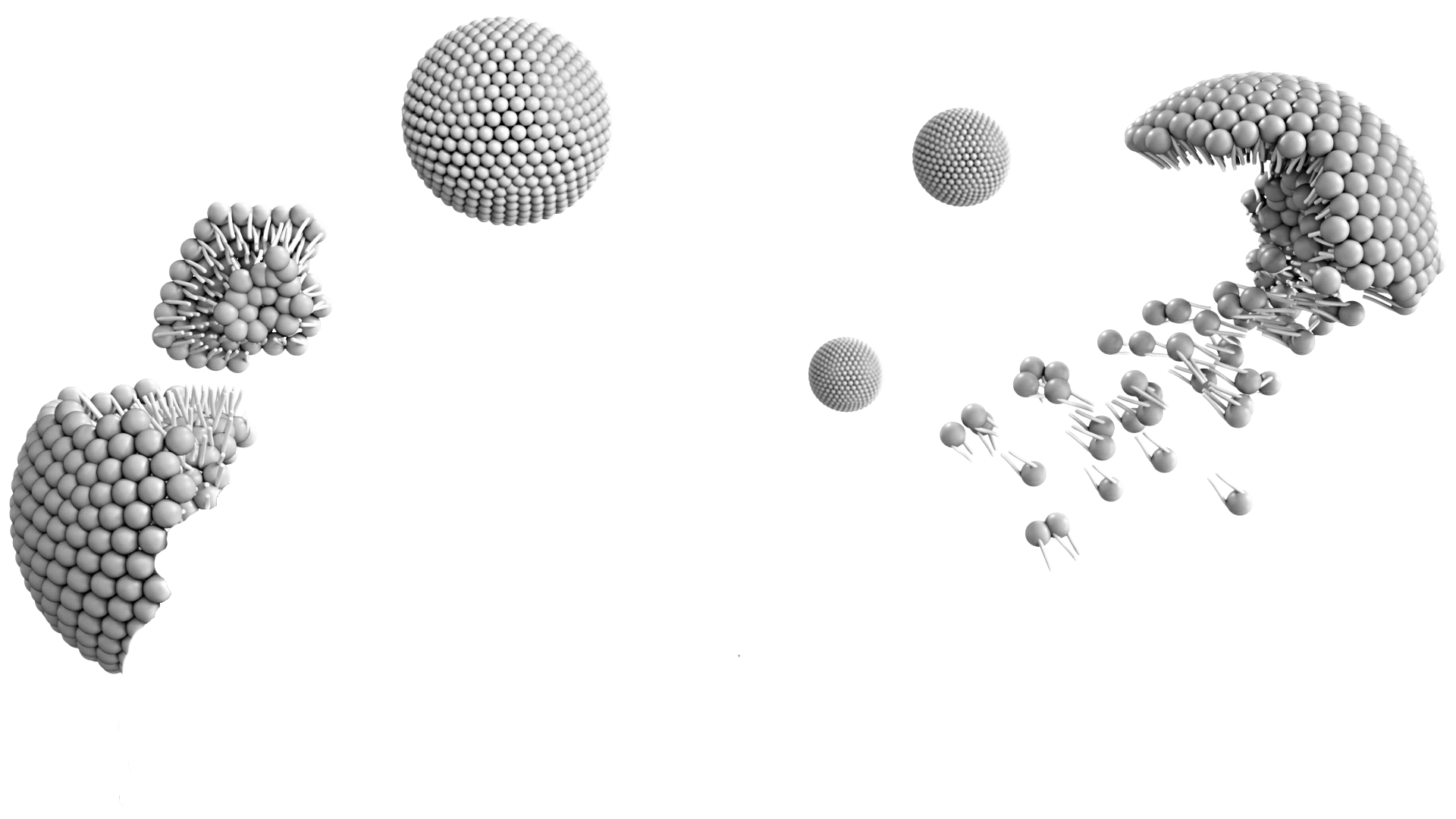
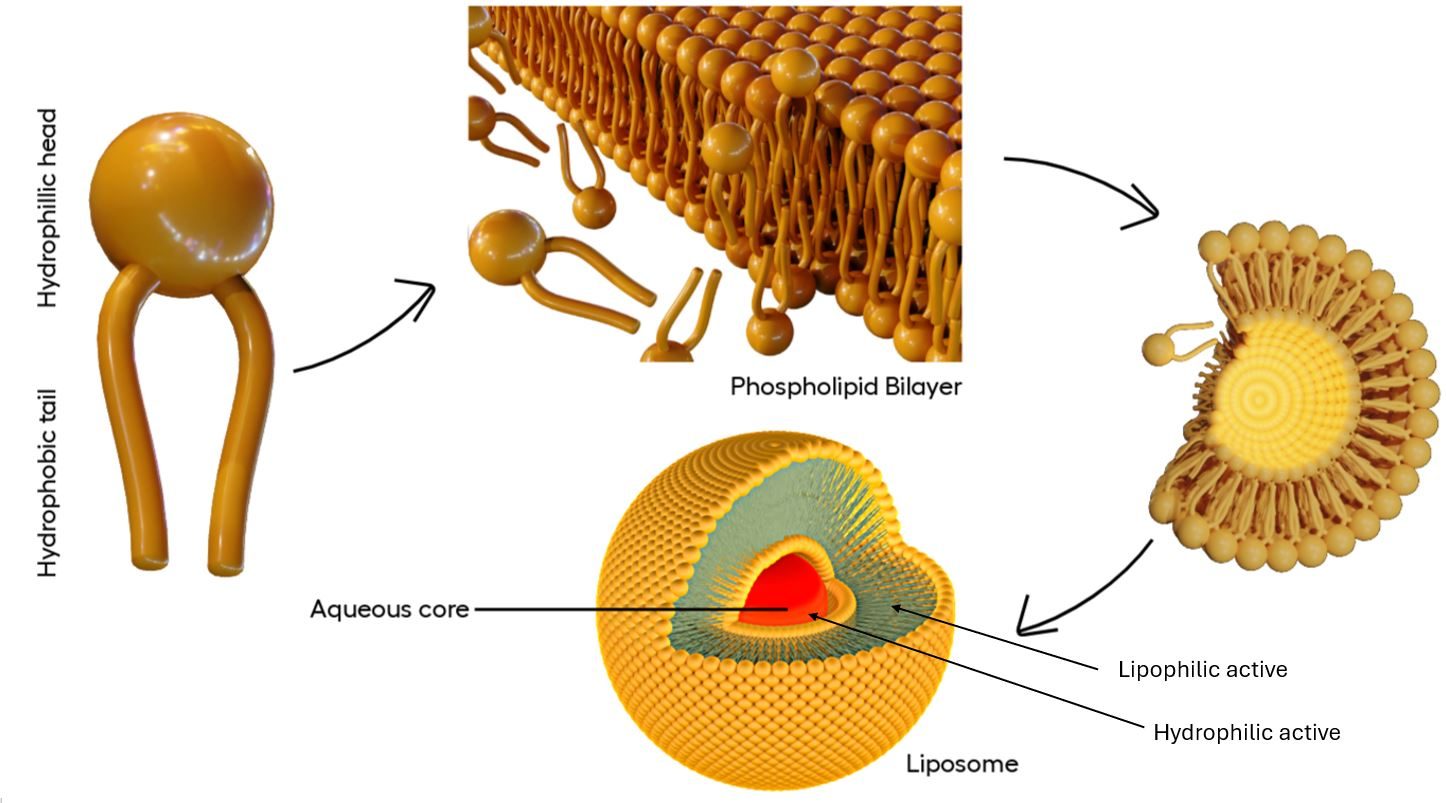
A liposome is typically formed from phospholipids arranged into a bilayer. This bilayer creates a vesicle, with an aqueous internal compartment and a lipid-based membrane. In simple terms, that means a liposome can be designed to accommodate different types of actives: hydrophilic compounds may associate with the aqueous core, while lipophilic compounds may associate with the lipid bilayer.
This structure is the reason liposomes have attracted decades of interest in drug delivery. They can be used to improve stability, alter distribution, support delivery of difficult molecules and, in some pharmaceutical settings, reduce toxicity or enable more targeted therapeutic use.
But the structure is the point.
A liposome is not simply the presence of fat, lecithin or phospholipids. It is an organised vesicular system. If that structure is not present, controlled and characterised, the product should not be assumed to be liposomal in any meaningful scientific sense.
___________________________________________
In pharmaceutical development, liposomal products are not casual mixtures. They are carefully engineered systems.
Clinically approved liposomal medicines, such as liposomal amphotericin B, doxorubicin-based liposomal medicines and other advanced formulations, are built around defined composition, controlled lipid-to-drug ratios, validated manufacturing processes and rigorous analytical characterisation. These products may include specific phospholipids, cholesterol and other excipients selected for a defined structural and functional purpose.
That controlled composition matters because liposomal behaviour is not determined by the active ingredient alone. It depends on the full architecture of the system: the lipid type, lipid purity, cholesterol content, lipid-to-active ratio, hydration process, particle size reduction method, manufacturing conditions, stability profile and final product environment.
In pharma, the term liposomal therefore carries a high burden of proof. It implies that the product has been designed, manufactured and characterised as a delivery system.
The nutraceutical sector’s interest in liposomal delivery is understandable.
For formulators and brands, liposomal delivery appears to offer an elegant solution. It gives a scientific rationale for improving the performance of difficult actives. It also provides a compelling consumer-facing message: advanced absorption, better delivery, superior technology.
Common candidates in the category include vitamin C, curcumin, glutathione and resveratrol — all actives frequently associated with bioavailability or stability challenges.
⇒ The rationale is not the problem. The problem is execution.
Liposomal delivery can be valuable when the system is properly designed. But it is not a universal shortcut. It is not automatically suitable for every active. It is not guaranteed by the presence of lecithin. And it is not proven by a particle size number alone.
This is where the gap between scientific formulation and market language begins to widen.
In a well-designed pharmaceutical liposomal system, the composition and structure are defined.
The lipid phase is selected deliberately.
Cholesterol may be included to support membrane stability. The active is incorporated according to a controlled formulation strategy. The structure is assessed using appropriate analytical methods. The product is developed within a quality system.
In many nutraceutical products, however, the situation can be far less clear.
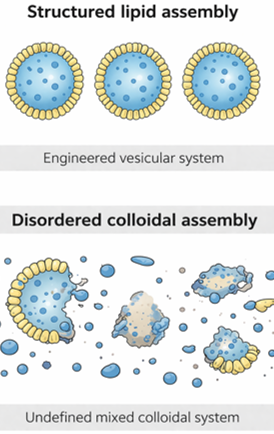
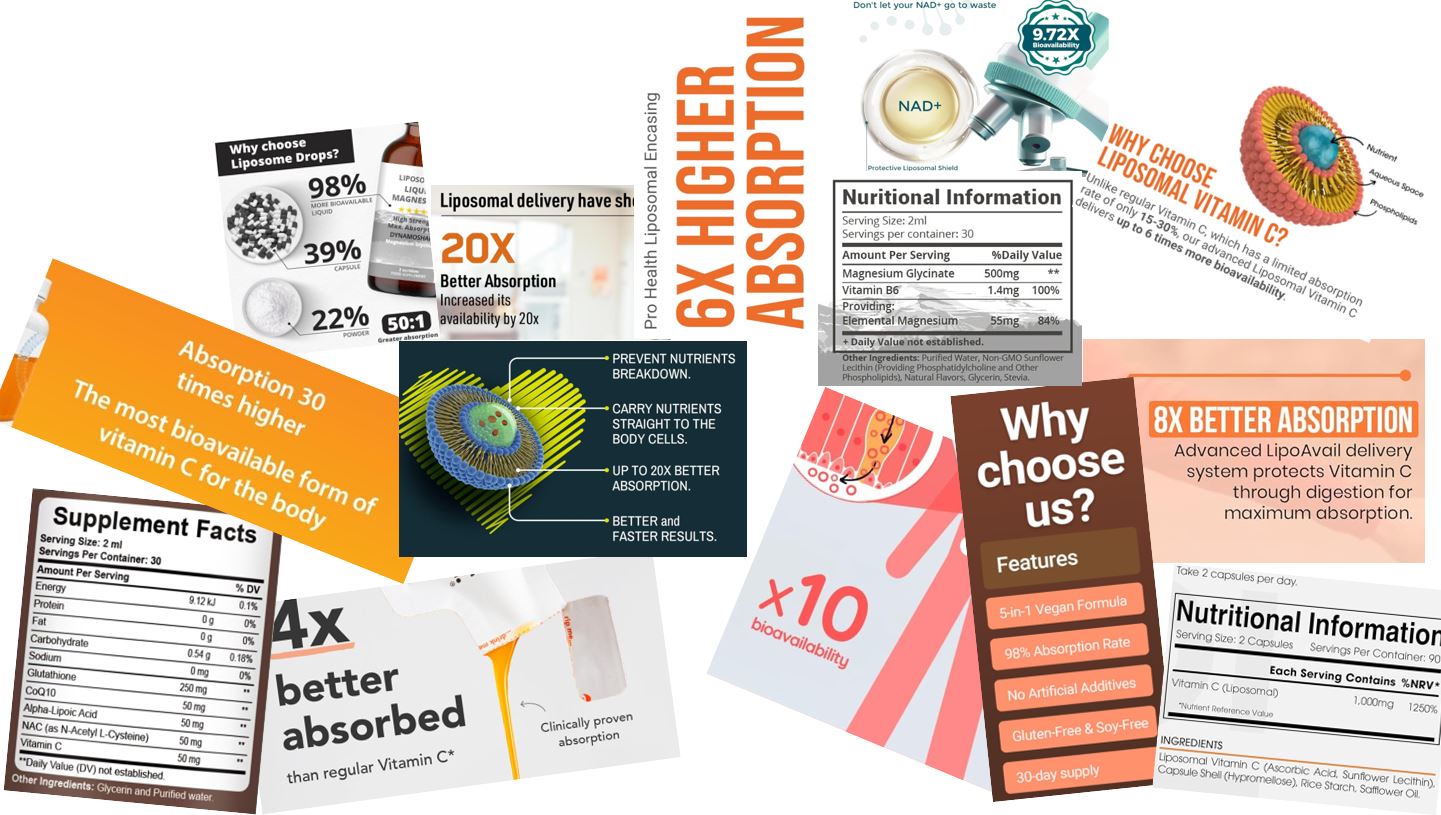
Some products are described as liposomal despite containing very low levels of phospholipid. Some appear to rely on generic lecithin rather than defined phospholipids. Some provide no meaningful information about lipid-to-active ratios. Some offer no evidence that vesicles are present. Others make absorption claims that are unsupported, exaggerated or poorly explained.
The result is a market in which products with radically different structures, compositions and quality standards may all use the same word.
A credible liposomal formulation requires more than enthusiasm for the concept. It requires the right materials, the right process and the right ratios.
Several common formulation errors undermine the structural credibility of liposomal claims.
___________________________________________
Particle size is another area where marketing language can outpace formulation science.
Smaller particles are often presented as inherently better. The implication is that “nano” automatically means superior absorption, stronger efficacy or more advanced delivery. But particle size alone is not enough.
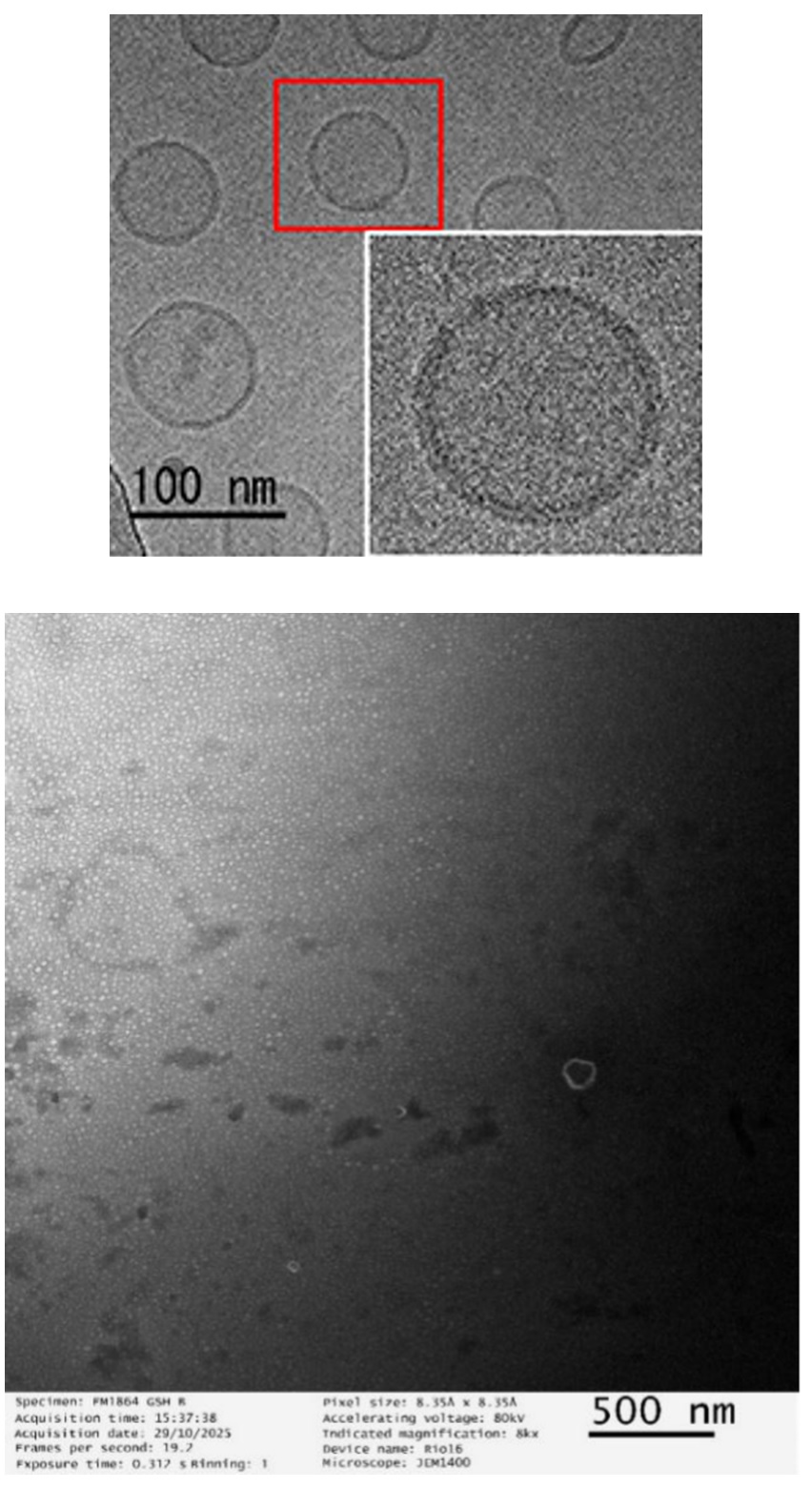
A small particle may be a liposome. It may also be a micelle, an emulsion droplet, a lipid aggregate, a fragment of disrupted material or a mixed colloidal structure. Without appropriate characterisation, a size measurement does not prove liposomal architecture.
For a liposomal claim to be meaningful, size should be considered alongside other parameters: particle distribution, polydispersity, morphology, lipid composition, encapsulation or incorporation efficiency, stability over time and behaviour under relevant storage or use conditions.
A number on a specification sheet cannot replace structural evidence.
Claimed structure v observed structure of “liposomal” supplement under TEM
Several claims now appear frequently across the nutraceutical market. Many sound persuasive. Some are oversimplified. Others are scientifically misleading.
Δ “If it contains phospholipids, it is liposomal.”
False. Phospholipids may be necessary for many liposomal systems, but their presence alone does not prove vesicle formation.
Δ “Smaller particles always mean better absorption.”
Misleading. Particle size can matter, but it is only one part of a much more complex delivery picture.
Δ “All actives can be effectively encapsulated.”
False. The suitability of an active depends on its physicochemical properties, stability, solubility, charge, molecular size, interaction with lipids and compatibility with the intended delivery architecture.
Δ “Liposomes survive oral delivery intact.”
Misleading. Oral delivery exposes liposomal systems to dilution, pH changes, bile salts, enzymes and digestive processes. Some structures may be designed to support delivery through this environment, but survival cannot simply be assumed.
Δ “Liposomal always means superior.”
False. A poorly designed liposomal product may be less credible than a well-designed non-liposomal formulation. The delivery system should fit the active, the dose, the format and the intended purpose.
One of the most concerning trends in the nutraceutical market is the use of liposomal language where the formulation appears to have little or no structural basis for the claim.
A product containing only a tiny fraction of phospholipid, for example, cannot automatically be assumed to have formed a meaningful liposomal system. If the vast majority of the formulation is active ingredient, sweetener, flavouring, carrier or other excipients, and only a trace amount relates to phospholipid content, the structural plausibility of the liposomal claim becomes questionable.
In some cases, products may be described as liposomal despite showing no obvious phospholipid basis at all. In others, lecithin may be used as the justification for the claim, even though lecithin appears in many ordinary food products and does not, by itself, create a liposome.
The comparison is simple: if the presence of lecithin alone made a product liposomal, then many everyday foods containing lecithin would also qualify. That is clearly not the case.
Without a meaningful threshold for composition, process and structural validation, “liposomal” becomes too easy to claim and too difficult for the consumer to interpret.
The same issue appears in another form through “clean label” claims.
Terms such as “third-party tested,” “naturally preserved” or “free from” specific preservatives can create a strong impression of reassurance. But such claims only hold value if they survive scrutiny.
Where products claim not to contain a preservative, but testing detects that preservative, the problem is no longer simply technical. It becomes a question of transparency, quality control and consumer trust.
This matters particularly in liquid liposomal nutraceuticals. Liquid systems can be microbiologically and chemically challenging. Stability, preservation, ingredient compatibility and shelf-life must be taken seriously. If a brand wants to avoid certain preservatives, it must have a credible formulation and preservation strategy to support that position. If it uses a preservative, it should label it accurately.
Consumers should not have to choose between scientific confusion and marketing reassurance.
Our industry can do better than that.
The nutraceutical market rewards simple messages. “Better absorbed.” “Advanced delivery.” “High strength.” “No preservatives.” “Nano technology.” “Liposomal.”
These phrases are commercially powerful because they are easy to understand and easy to sell.
Science requires more.
⇒ It requires asking whether the active is suitable for liposomal delivery in the first place.
⇒ It requires selecting the right lipid system.
⇒ It requires determining whether the formulation can physically support vesicle formation.
⇒ It requires validating the structure.
⇒ It requires manufacturing reproducibility.
⇒ It requires stability data.
⇒ It requires quality control.
⇒ It requires restraint in the claims made to consumers.
This is not always the shortest route to market. It is not always the easiest route to a premium price point. But it is the route that protects the long-term credibility of the category.
The first question should not be: “Can we call this liposomal?”
The first question should be: “What delivery architecture does this active actually require?”
From there, development should consider:
This is the difference between formulation as a marketing exercise and formulation as a scientific discipline.
A properly developed liposomal nutraceutical does not need to rely on vague language. It can explain what it is, why it was designed that way and how the system is controlled.
One of the most important messages for the nutraceutical sector is that higher standards are not commercially impossible.
Research-led formulation can translate into controlled manufacturing. Quality-led development can coexist with market delivery. Scale-up, validation and commercial production are not opposing forces; they are parts of the same responsible development pathway.
The challenge is not that nutraceutical products cannot be scientifically credible. The challenge is that the market has not always required them to be.
That is beginning to change.
As liposomal supplements become more mainstream, consumers, practitioners, retailers and regulators are likely to ask more difficult questions. Brands will increasingly need to show that their delivery claims are not just attractive, but technically defensible.
The companies that have built their products around genuine formulation science will be better placed for that future.
The future of liposomal nutraceuticals should not be about using the word more often. It should be about using it more accurately.
That means recognising both the power and the limits of liposomal delivery.
Liposomes can be highly valuable for the right active, in the right system, with the right manufacturing and validation. But they are not universally appropriate. Some actives may require different lipid-based architectures. Some may be better served by non-liposomal delivery strategies. Some may not need advanced delivery at all.
True innovation is not forcing every ingredient into the same fashionable technology. True innovation is understanding the active, understanding the formulation challenge and designing the most appropriate system around it.
That is where the nutraceutical industry has an opportunity to move beyond claims and into genuine delivery science.
The liposomal supplement market is growing because the underlying idea is compelling. Consumers want products that are better designed. Practitioners want formulations they can trust. Brands want meaningful differentiation. Manufacturers want platforms that can support innovation.
But growth without standards risks undermining the very science that made the category attractive in the first place.
The industry does not need to abandon liposomal delivery. It needs to define it properly.
It needs clearer expectations around composition, structure, manufacturing, characterisation and claims. It needs to distinguish between phospholipid-containing products and true liposomal systems. It needs to stop presenting particle size as proof of delivery. It needs to challenge unsupported absorption claims. It needs to ensure that clean-label promises are matched by analytical reality.
Above all, it needs to respect the difference between a delivery system and a label claim.
Liposomal technology has earned its place in pharmaceutical science because it is engineered, characterised and controlled. If the nutraceutical sector wants to borrow the language of that science, it must also accept the responsibility that comes with it.
The future belongs not to the loudest liposomal claim, but to the most credible formulation.